Best fit
Large Redis-style datasets where DRAM, replicas, and shards dominate cost.
EloqKV
EloqKV uses NVMe-backed storage to keep large datasets fast at much lower cost.
lower infra cost (1TB example)
P99.99 latency on NVMe
compatible API
Trusted by teams running data at scale




What is EloqKV?
EloqKV is a Redis- and Valkey-compatible database that serves datasets far larger than RAM — at cache speed, with full ACID transactions.
Large Redis-style datasets where DRAM, replicas, and shards dominate cost.
Session stores, user profiles, shopping carts, feature stores, and leaderboards — where the dataset dwarfs the hot working set.
DRAM to NVMe economics
In the 1TB / 100K QPS / HA example below, EloqKV runs at about $650/mo versus about $33,120/mo on ElastiCache — more than 50× lower infrastructure cost.
| Option | Monthly infrastructure | Relative cost | Data placement |
|---|---|---|---|
| EloqKV | $650/mo | 1x baseline | 2 x i4i.2xlarge, each with 8 vCPU and 1 x 1875 NVMe SSD |
| ElastiCache for Redis OSS | $33,120/mo | 51.0x vs EloqKV | 26 x cache.r7g.4xlarge (13 shards x primary+replica) |
| Redis Cloud Pro | $35,018/mo | 53.9x vs EloqKV | Official Redis calculator estimate: 82 x Large shards for 2TB effective HA memory |
Assumptions: 1TB logical dataset, 100K QPS, P99.99-under-5ms latency target, HA included, us-east-1, and 730 hours/month. EloqKV uses EC2 1-year Standard Reserved, No Upfront pricing. Excludes transfer, snapshots, support, and discounts. Pricing reviewed June 2026. Calculate savings for your workload.
Predictable tail latency
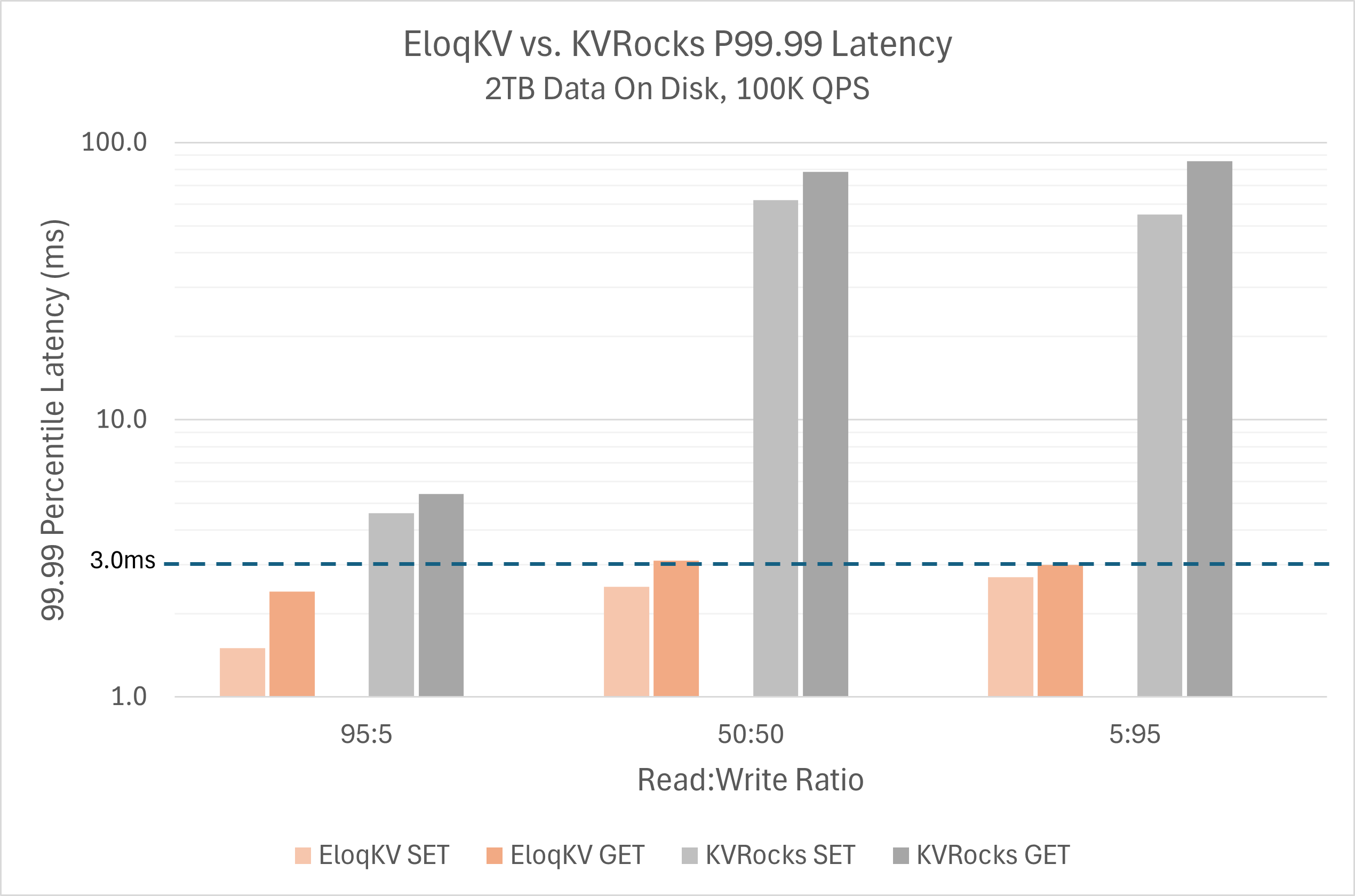
The tail-latency spikes that break other SSD-backed caches come from LSM compaction stalls and write amplification. EloqKV's storage engine drops the LSM design entirely — one disk access per read, no background compaction — so P99.99 stays flat. A 2TB dataset holds P99.99 under 5ms on a single NVMe node, work that would otherwise need a ~20-node all-RAM Redis cluster.
P99.99 at 2TB on NVMe
per read — no LSM levels
stable on a single node
Beyond cache
EloqKV is full ACID with distributed transactions, so it covers workloads a cache cannot — without giving up the Redis interface.
Cross-shard MULTI/EXEC with consistent reads and writes — not just single-key atomics.
Retire the MySQL + Redis combo and its cache-invalidation logic. One system is the source of truth and serves it at cache speed.
Run cache-style for raw speed, or enable WAL-backed recovery when the workload needs durable state.
Redis & Valkey wire-compatible. Point your existing clients, libraries, and tooling at EloqKV unchanged.
How it compares
EloqKV's goal is to trade nothing — capacity, tail latency, and transactions at once.
| Capability | EloqKVRedis API on NVMe | In-memory cacheRedis · Valkey · ElastiCache | SSD / tiered KVe.g. KVRocks |
|---|---|---|---|
| Serves datasets beyond RAM | ✓ | ✗capped by DRAM | ✓ |
| P99.99 below 5ms under load | ✓non-LSM engine | ✓all-DRAM | ✗LSM compaction jitter |
| Distributed ACID transactions | ✓cross-shard MULTI/EXEC | ✗single-shard only | ✗limited |
| Infra cost, 1TB + HA | 1× · $650/mo | ~51× | Lower DRAMbut unstable tail |
| Redis / Valkey wire API | ✓ | ✓ | ✓ |
P99.99 vs KVRocks measured on a 2TB on-disk dataset at 100K QPS. See the benchmark.
FAQ
EloqKV is a Redis-compatible key-value database for large datasets that are too costly to keep entirely in DRAM. It uses NVMe-backed storage with optional persistence. Read the EloqKV docs.
Redis cost scales with memory and replicas. EloqKV serves large datasets from NVMe and object storage, so capacity planning starts from total dataset size and HA needs. See the cost breakdown.
EloqKV combines NVMe-aware storage with asynchronous execution to keep P99.99 latency below 5 milliseconds, measured on a 2TB dataset at 100K QPS. Results depend on hardware, key size, access pattern, peak QPS, and durability settings. Review the latency benchmark.
No. Run cache-style, or enable WAL-backed persistence when recovery is required. Learn about durability.
EloqKV is Redis and Valkey compatible, but teams should validate commands, cluster behavior, latency, and operations before migration. Check command compatibility.
Mirror data, validate reads and commands, then move writes after the target deployment is caught up and monitored. Read the migration guide.
Evaluate EloqKV