MinIO Community Edition Enters Maintenance-Only — Can You Still Trust Your Self-Hosted S3?

Introduction
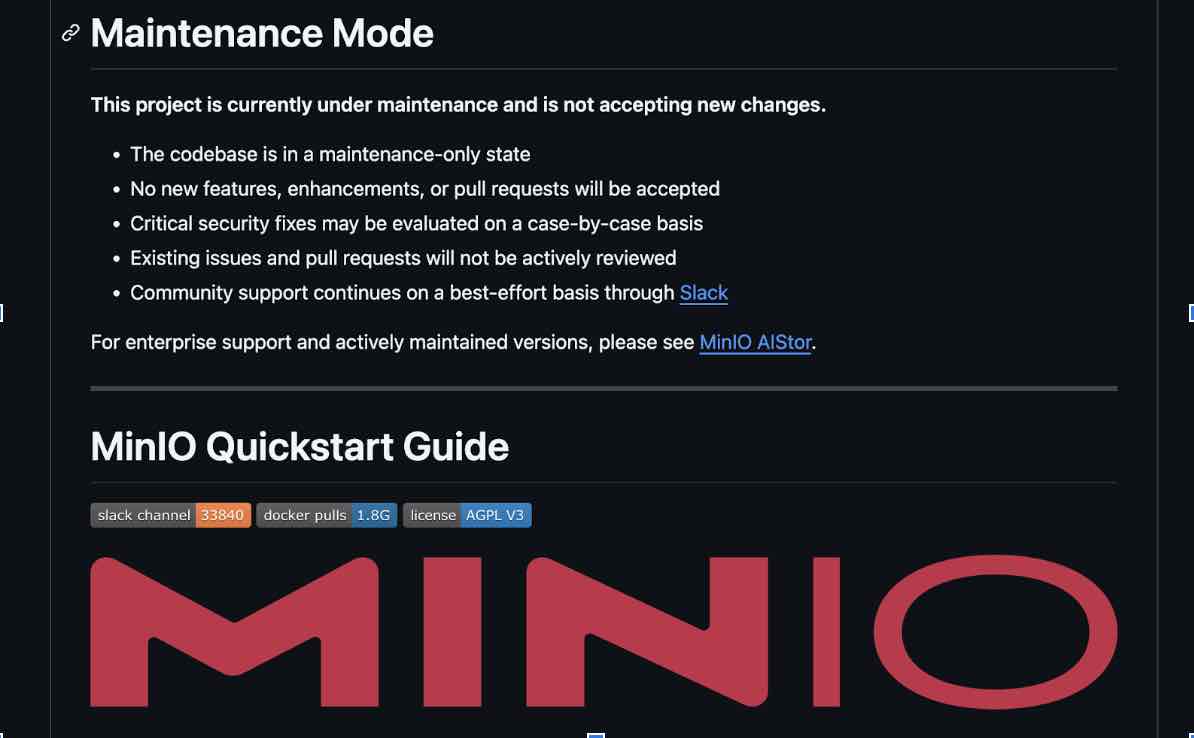
MinIO has officially moved its Community Edition to a “maintenance-only” release model:
- No more prebuilt binaries from the community.
- No regular acceptance of new features or PRs.
- Only critical security patches will be handled when necessary.
In plain terms: If your production object storage is built on MinIO Community Edition, you are now carrying hidden operational risk and rising maintenance costs.
For SREs: Three Things To Do Immediately
-
Classify your MinIO usage:
- Mission-critical production
- Non-critical environment
- Test / dev only
-
For critical workloads, start a 48-hour PoC immediately.
-
Select candidates that are:
- S3-compatible
- Actively maintained
- Commercially supportable (e.g., Ceph RGW, SeaweedFS, RustFS), and run compatibility regression tests.
Part I: Why This Is Not “Minor News” — Real Engineering Risks
Many teams treat object storage as the foundation of their infrastructure: cold data, backups, logs, media, and user uploads all live there.
Unlike databases or message queues, the risk of an unmaintained object storage layer is not sudden downtime, but:
- Extended patch windows
- Growing compliance risk
- Rising operational burden
Once your S3 endpoint is public-facing and used with cross-region replication, IAM, and access control, even subtle incompatibilities in headers or signatures can become incident triggers.
Part II: Viable Alternatives in 2024–2025
Selection criteria:
- S3-compatible
- Active releases or commercial support
- Ability to provide patches and vendor/community support
Below is a quick engineering-focused comparison:
| Object Storage | Introduction | Engineering Appraisal | Repo |
|---|---|---|---|
| Ceph (RGW) | Distributed object, block, and file storage platform | Enterprise-grade, native S3 compatibility. Complex to deploy but the most stable with strong vendor backing. Best for high-capacity, high-reliability teams. | https://github.com/ceph/ceph |
| SeaweedFS | High-performance distributed storage for billions of files | Lightweight, strong horizontal scalability, active S3 layer. Good for fast deployment and teams tolerant of minor compatibility gaps. | https://github.com/seaweedfs/seaweedfs |
| RustFS | High-performance, Rust-based S3-compatible object store | Claims 2.3× MinIO performance on 4KB objects. Provides Helm and Docker resources for Kubernetes. Young but promising. | https://github.com/rustfs/rustfs |
| OpenIO | Open-source object storage for large-scale unstructured data | S3-compatible, hardware-agnostic, strong UI, designed for big data and massive scale. | https://github.com/open-io |
| Apache Ozone | Scalable distributed object store for analytics and data lakes | Hadoop-native, optimized for analytics and container platforms, supports billions of objects. | https://github.com/apache/ozone |
| Garage (Deuxfleurs) | Lightweight, distributed, S3-compatible object store | Designed for smaller self-hosted setups, geo-replication friendly. Suitable for edge and private clusters. Some advanced S3 features may be missing. | https://github.com/deuxfleurs-org/garage |
Quick Engineering Rule of `Thumb
- Need full S3 features (versioning, lifecycle, ACLs, multipart)? → Ceph or commercial vendors first.
- Only need basic read/write? → SeaweedFS or RustFS are fast to PoC.
Part III: A 48-Hour PoC Using SeaweedFS (Copy-Paste Friendly)
Goal: Within 48 hours, produce quantifiable results to support decisions:
- Compatibility gaps (API / headers / multipart / ACL)
- Throughput & latency (P50 / P95 / P99)
- Operational complexity (steps, recovery time, scriptability)
- Failure recovery behavior (node failure → consistency)
Recommended Time Allocation
| Phase | Time |
|---|---|
| Preparation & deployment | 0–6 hours |
| Data migration & concurrency benchmarks | 6–18 hours |
| Compatibility testing | 18–30 hours |
| Ops drills & fault injection | 30–42 hours |
| Summary & decision matrix | 42–48 hours |
Environment Requirements
- CPU: ≥4 vCPU per node (2 minimum)
- Memory: 8–16 GB per node (Ceph: 16GB+ recommended)
- Disk: 500GB–1TB per node (500GB enough for PoC)
- Network: 1Gbps or better
- OS: Ubuntu 20.04/22.04 or CentOS 8/9
- Nodes: minimum 6
Common Setup Script (Run on All Nodes)
#!/usr/bin/env bash
sudo apt update
sudo apt-get install s3cmd

set -euo pipefail
WORKDIR="${PWD}/s3_distributed_poc"
mkdir -p "$WORKDIR"{/seaweed,/scripts,/data}

for cmd in s3cmd ; do
  if ! command -v $cmd >/dev/null 2>&1; then
    echo "Warning: $cmd not installed."
  fi
done

cat > "$WORKDIR/README.md" <<'EOF'
Directory layout:
- seaweed/: SeaweedFS deployment and benchmarks
- scripts/: General test scripts
EOF
echo "Init done"
Run:
chmod +x poc_setup_common.sh
./poc_setup_common.sh
SeaweedFS Deployment (3-Master + 3-Volume Example)
Assumed nodes:
node1: 10.0.0.11
node2: 10.0.0.12
node3: 10.0.0.13
node4: 10.0.0.14
node5: 10.0.0.15
node6: 10.0.0.16
Create directories (run on all nodes):
mkdir -p /data/seaweedfs/{master,volume,filer,data}
Start masters on node1/2/3:
nohup ./weed master -port=9333 -mdir=/data/seaweed/master -defaultReplication=001 -ip=10.0.0.11 -peers=10.0.0.11:9333,10.0.0.12:9333,10.0.0.13:9333 >> master.log 2>&1 &
(Repeat for three nodes)
Start volume servers on node4/5/6:
nohup ./weed volume -port=9334 -dir=/data/seaweed/volume -max=30 \
  -mserver=10.0.0.11:9333,10.0.0.12:9333,10.0.0.13:9333 \
  -dataCenter=dc1 -rack=rack1 -publicUrl=10.0.0.14:9334 -ip=10.0.0.14 >> v1.log 2>&1 &
Verify:
curl http://10.0.0.11:9333
Run filer + S3 gateway:
./weed filer -s3 -ip=10.0.0.1x -master=10.0.0.11:9333,10.0.0.12:9333,10.0.0.13:9333
Benchmark Script
The benchmark script can be downloaded at EloqData Objecrt Storage Benchmark
Benchmark with the following commands:
# generate local files
./s3_concurrent_test.sh prepare
# upload local files to object storage
./s3_concurrent_test.sh upload
# download files in object storage to local
./s3_concurrent_test.sh download
# test upload and download concurrently
./s3_concurrent_test.sh both
# cleanup object storage with prefix
./s3_concurrent_test.sh cleanup
Key Metrics
| Metric | Meaning | How to Measure |
|---|---|---|
| Throughput | Data per second (MB/s or req/s) | Total bytes / total time |
| Latency | Single request response time | p50/p90/p99 via curl or scripts |
| Error Rate | Failed request ratio | Non-zero s3cmd or HTTP 4xx/5xx |
| Availability | Uptime | Health checks / ping |
| Concurrency | Performance under load | Increase concurrency until degradation |
| Data Integrity | Data correctness | md5/sha256 comparison |
Part IV: From EloqData's Perpective
EloqData provides two production-grade databases:
- EloqKV: A Redis-compatible transactional KV database
- EloqDoc: A MongoDB-compatible document database
Both are designed to use S3-compatible object storage as primary storage, eliminating traditional disk overhead and unlocking elastic scalability. EloqData also offers a 25GB Free Tier cloud service at EloqCloud.
MinIO moving into maintenance mode does not mean the market is abandoning object storage — quite the opposite. Object storage is becoming the foundation of next-generation databases:
- From Snowflake/Databricks-style lakehouse systems
- To Kafka / Pulsar streaming platforms
The real challenge today is: How to unlock object storage for ultra-low-latency, high-concurrency OLTP workloads.
EloqData provides an answer:
- EloqKV: a fully Redis-compatible transactional KV database, achieving sub-3ms P9999 latency under million-QPS workloads using disk-only reads.
- EloqDoc: a MongoDB-compatible document database using a decoupled compute/storage architecture for elasticity and dramatic cost reduction.
Unlike traditional cloud-disk architectures, EloqKV and EloqDoc use object storage as primary storage and local SSD as an intelligent cache, reducing total storage cost to one-tenth of traditional solutions.
With native multi-replica object storage, EloqData enables a single-compute + multi-storage replica HA model, dramatically reducing CPU and memory overhead.
Object storage also enables second-level backup and branching, turning backup, environment cloning, and testing workflows from hours into seconds.
MinIO’s transition is not the end of object storage — it is the beginning of a new cloud-native infrastructure era. With a proprietary quad-decoupled architecture, EloqData breaks the performance limits of object storage in OLTP scenarios and is helping define the next generation of cloud-native databases.
EloqData — bringing object storage into the OLTP core battlefield.
Register at https://cloud.eloqdata.com and get 25GB free storage and 10,000 QPS free DBaaS.